



If an employee wants to use a new AI tool tomorrow, who approves it?
If AI produces an inaccurate client communication, who reviews it?
And if someone accidentally shares confidential information, who needs to know?
These questions reveal something an AI subscription or written policy cannot resolve on its own: your business needs clear ownership of how AI is used.
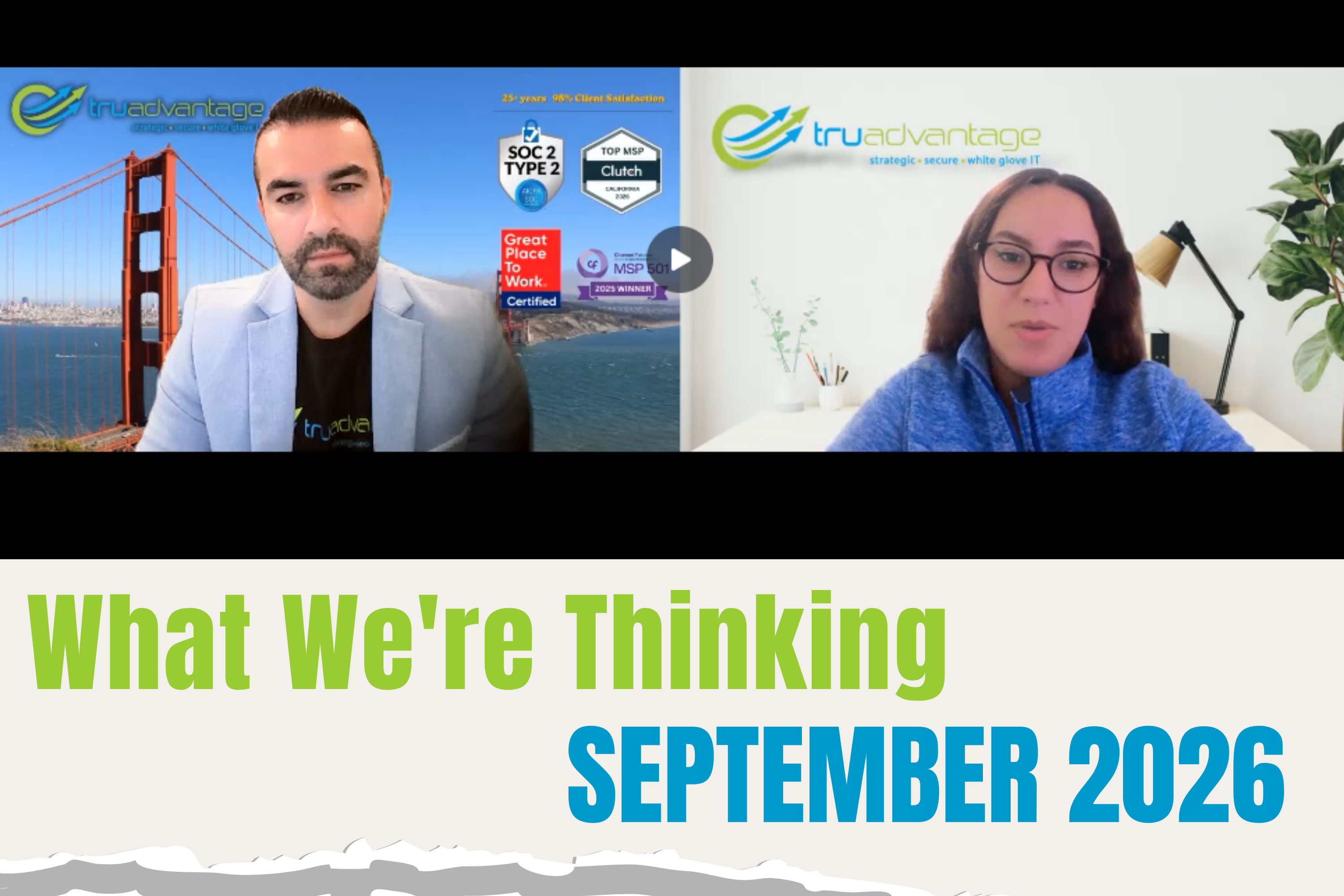
In our recent TruAdvantage SMB Thought Leadership Webinar, AI in the Workplace: How to Use It Without Putting Your Business at Risk, Kayvan Yazdi and Latifa Afitou explored this challenge.
The central message was straightforward: someone needs accountability for the AI program, and successful adoption requires collaboration across the business.
For small and midsize organizations, that starts with defining who makes decisions, who puts safeguards in place, and who checks that AI is helping employees do useful work.
When Everyone Assumes Someone Else Is Responsible
Consider a hypothetical professional services firm.
The marketing team uses AI to draft content. Operations experiments with meeting summaries. A department manager wants to connect an AI assistant to internal files.
Leadership assumes IT is managing the risks. IT assumes department managers have approved the business uses. Managers assume employees know what information they can share.
Everyone has a reasonable expectation. Nobody has confirmed who owns the decisions.
That gap can lead to inconsistent practices, stalled projects, and unanswered questions about company data.
A practical AI ownership model makes the responsibilities visible before those assumptions become problems.
Need Managed IT Services?
We are an Award-winning IT Provider and Comprehensive IT Solutions in San Francisco, San Jose, and throughout the Bay Area.
Schedule A Free Consultation
Need Managed IT Services?
We are an Award-winning IT Provider and Comprehensive IT Solutions in San Francisco, San Jose, and throughout the Bay Area.
Schedule A Free ConsultationLeadership: Set Direction and Assign Accountability
Leadership determines what the business wants to achieve with AI and what level of risk it is prepared to accept.
That includes deciding which business problems deserve attention, allocating resources, and establishing boundaries around acceptable use.
Leaders should also name an accountable AI program owner. Depending on the organization, that might be the COO, an operations director, an IT leader, or another manager with the authority to coordinate across departments.
This person keeps decisions moving, brings the right people into discussions, and makes sure unresolved concerns reach leadership.
Questions for leadership include:
- What business outcomes are we trying to improve?
- Who has authority to approve or decline a proposed use?
- Which decisions require additional review?
- Who is responsible for following up as tools and needs change?
An SMB can begin with existing staff. The essential step is assigning responsibility explicitly and giving that person enough time and authority to carry it out.
IT and Security: Evaluate Tools and Protect Information
IT and security evaluate whether the technology is appropriate for the proposed use.
Their responsibilities include reviewing access requirements, account administration, integrations, and how the tool handles information. They also help put available technical safeguards in place.
A request to draft text from public information requires a different review from a request to connect AI to shared client folders.
The business team needs to explain what it wants to accomplish and what information the workflow requires. IT then has the context needed to evaluate the setup.
Approval should specify the permitted use and data, rather than leaving employees to assume that an approved tool can be used for anything.
For an SMB working with a managed IT provider, clarify which evaluations and controls the provider supports and which decisions remain with the business.
Department Managers: Own the Workflow and Its Results
Department managers understand the work well enough to identify useful AI opportunities and recognize unacceptable results.
They should define the task, select an appropriate reviewer, and determine whether the workflow improves performance.
For example, a manager testing AI-generated client updates should establish which source information employees may use, what the draft must include, and who approves it before sending.
Managers also need to check whether the benefits hold up in practice. A fast first draft may provide little value if employees spend longer correcting it than they previously spent writing it.
Their responsibility is to make sure the workflow delivers acceptable work and follows the organization’s approved process.
Employees: Follow the Boundaries and Review Their Work
Employees need clear, practical instructions they can apply during a busy workday.
They should know which tools and uses are approved, what information they may share, and when a result requires additional review.
Their responsibilities include:
- Using approved tools within the permitted scope.
- Checking AI-generated work before relying on or sharing it.
- Asking when data rules or approval requirements are unclear.
- Reporting mistakes, unexpected behavior, or suspected data exposure promptly.
Give employees a named contact or clear reporting route. Instructions such as “use AI responsibly” are difficult to apply without examples and someone available to answer questions.
HR, Legal, and Compliance: Help Define Appropriate Use
The webinar also identifies a role for HR, legal, and compliance.
These functions help evaluate proposed uses that touch employee information, client obligations, internal policies, or regulated activities.
An SMB may rely on outside advisers for some of this support. The AI program owner should know when to involve them.
For example, drafting a general office announcement and using AI to evaluate job applicants raise very different questions. An approval process should recognize that difference and bring in the appropriate expertise.
A Practical Responsibility Map for SMBs
Use this as a starting point and replace each role with a named person or team.
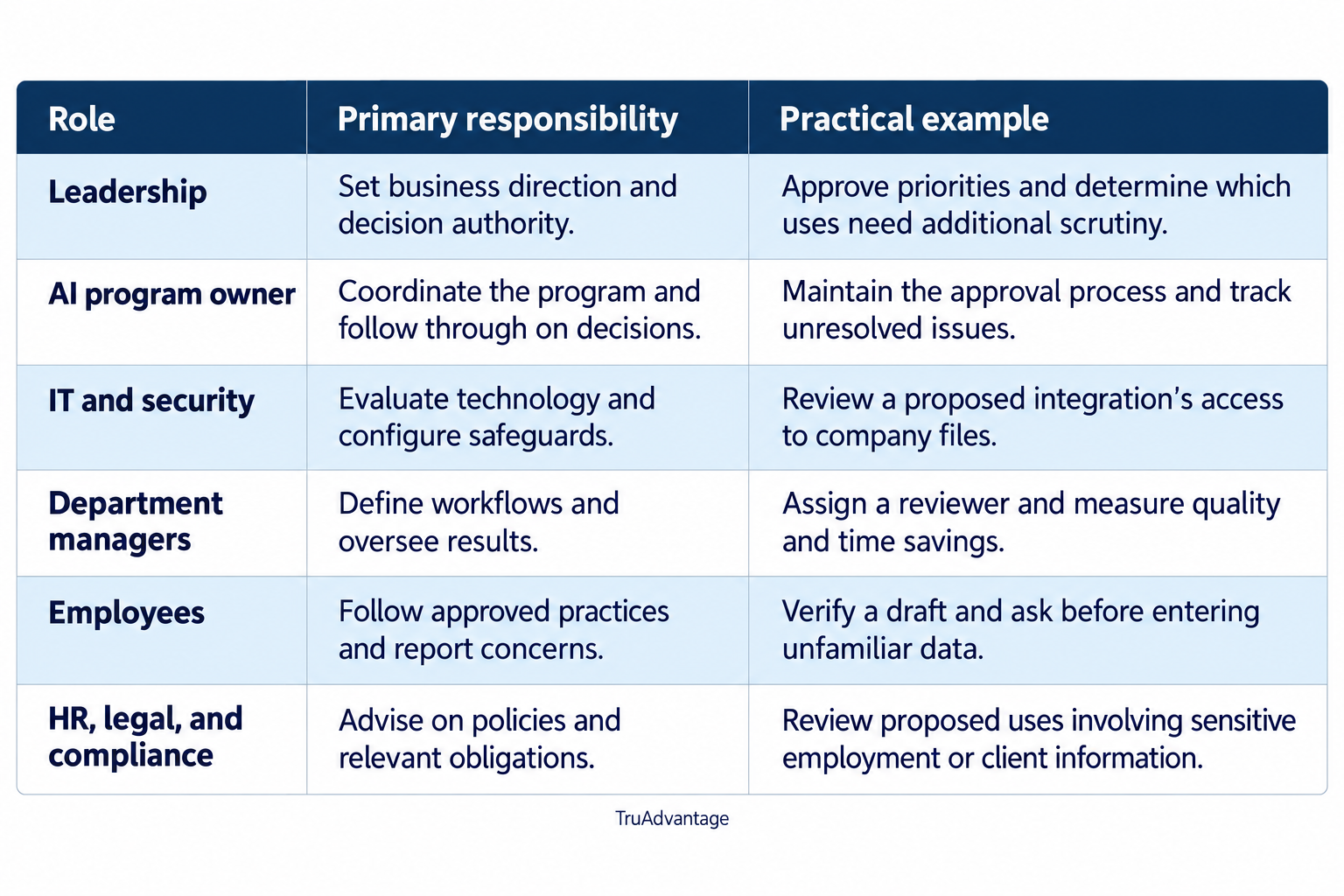
One person may fill several roles in a smaller business. What matters is that each responsibility has an owner and that employees understand how decisions get made.
Make the Approval Process Easy to Follow
A short request can give the right people enough information to evaluate a proposed AI use.
Ask employees or managers to document:
- The task they want to improve.
- The AI tool they want to use.
- The information it would need.
- Who will check the output.
- The expected business benefit.
The department manager can assess the workflow. IT and security can evaluate the technology and information access. The program owner can coordinate additional review and record the decision.
Document the approved scope so the next employee does not have to guess what is allowed.
One Action for Your Next Leadership Meeting
Ask everyone in the room:
“Who is accountable for AI in our business, and what decisions does that person own?”
If the answers differ, start there.
Name the accountable owner, identify the supporting roles, and give employees a clear place to bring questions. Then apply that structure to one existing AI workflow.
That creates a practical foundation for expanding AI use with greater confidence.
How TruAdvantage Helps Your Business
Book Your Free Consultation Now
Iman Oskoorouchi Iman Oskoorouchi, President and Co-founder of TruAdvantage, studied Electrical Engineering at UC Davis and holds multiple IT certifications. With over two decades of experience helping Bay Area and California businesses and healthcare practices navigate digital transformation, Iman is known for his personal touch and deep industry expertise. He believes technology should serve people first, then systems, combining technical insight with a human-centered approach to build secure and efficient IT environments. A lifelong learner inspired by books like The Untethered Soul and The 5AM Club, he finds balance in backcountry skiing, philosophy, and Thai green curry.
President, Co-Founder
Categories: Blog